

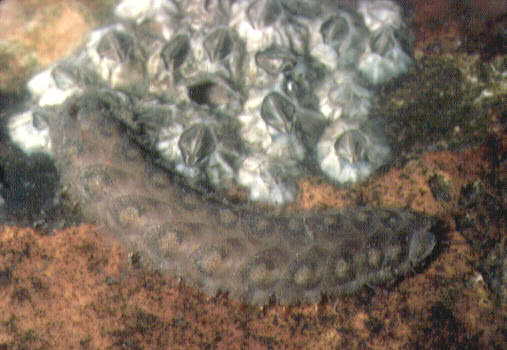
These are marine worms (Polychaetes) which have dorsal scales. These coverings over the back of the animal are important for identification as the number and size vary with the species.
The scale worms search for prey, mainly small crustaceans and worms, from under stones, rocks and seaweeds. After mating the female retains the eggs and thus prevents them entering the plankton. Mortality rates in the plankton are high and so organisms exploiting this environment must produce massive numbers of young to ensure survival of the species. The larvae of scale worms are shed direct on to the seashore into crevices.
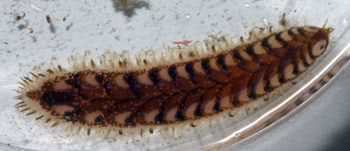
The scale worm Lepidonotus sp.
Scale worms live under stones and seaweeds of rocky seashores, usually in the lower shore although they do stray up into the middle shore. Common in the Atlantic coastal areas. There are similar species in the Mediterranean.
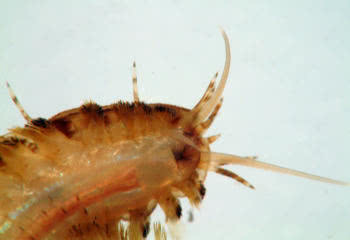
Underside of scale worm head
The family, Aphroditidae, has a delightful species known as the Sea Mouse (Aphrodite aculeata) which is an iridescent green, 10 cm long with a thick body covered in hair. Found on sand off shore.
Looking for a next step?
The FSC offers a range of publications, courses for schools and colleges and courses for adults, families and professionals that relate to the seashore environment. Why not find
out more about the FSC?

FEEDBACK
Do you have any questions?
Copyright © 2008 Field Studies Council

Creative Commons Attribution-Noncommercial-No Derivative Works 3.0 Licence .
Site Statistics by Opentracker